
My maternal grandmother’s house was a sanctuary to me – a place of unconditional love. We visited my grandmother every Saturday when I was growing up, and she often cared for me and my siblings when we were sick, while our parents worked. I feel such a strong connection to the house that it almost feels like an ancestor.
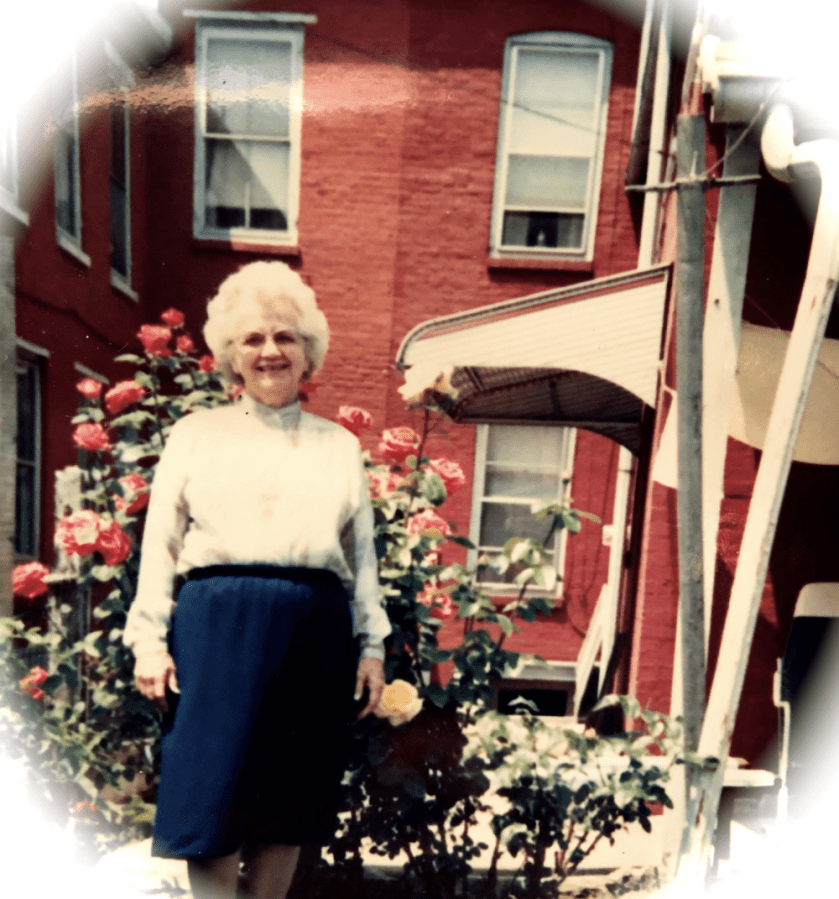
To us, she was simply Grandmom S. My grandmother was born Helena Catharine Menet in 1911, according to her birth and baptismal certificates, but by the time she was our grandmother she was known as Harriet Schneidenwind. I wondered why, as the fourth child and middle daughter of Polish immigrants, she chose (or was given) the German name of Harriet (which I understood to be its origins). Her parents emigrated in the 1890s from Austrian-partitioned Poland (known as Galicia), whose residents mostly spoke German, so perhaps that explains the connection? However, my great-grandparents, Galician peasants who identified as Polish, spoke that language, and my grandmother, raised in a Polish-speaking home in America, spoke only Polish until the first grade of elementary school.
However! I discovered that Harriet is the English version of the French name Henriette, according to Wikipedia. And since the surname of my great-grandfather, Menet, is French in origin, that makes more sense! Menet is an uncommon surname in Poland, but there are a few Poles who have that last name. (I have yet to trace my Polish ancestry back to France, and I don’t know that I’ll ever be able to, since my Polish ancestors left few records, and those are mostly in Poland.)
Okay, enough on that tangent! Back to the house …
As of this year, 2025, my ancestors and their descendants have owned the house on South Fifth Street for 100 years. My great-grandfather, Hieronim (Henry) Menet, bought the house in 1925. My grandmother, who married Charles Schneidenwind in 1941, inherited the house from her father in 1945, and a Schneidenwind has lived in that house ever since, for the past 80 years.
My uncle, the current owner and resident, wanted to know the history of my grandmother’s house, which prompted this research, as I’m fascinated by the history of old houses, especially this old house that is so precious to me. The house was built ca. 1846, in Reading, Pennsylvania, now located in the Callowhill Historic District. (Interestingly, there is also a Callowhill Historic District in Philadelphia, the city to which I moved after college.)
One of the families that owned the house in the 19th century was the Houder family, who resided in that house for 36 years, from 1856 to 1892. The Houder family then sold the house to the Allgaier family. While searching a newspaper archive for stories about those families, along with the other previous residents, I made two significant discoveries.
The son of Daniel and Eliza (Silknitter) Houder, Jacob Houder, was killed in the Civil War in 1864, and his funeral was held in his family home, likely in the front parlor of the house where I would spend many happy hours with my grandmother over a century later. Captain Jacob Houder moved up quickly through the ranks of the 88th Pennsylvania Volunteer Infantry Regiment, which he commanded before he was killed at the age of 23 in Petersburg, Virginia. Although the Houders are not on my family tree, I immersed myself in Civil War research, eager to learn all I could about the 88th Pennsylvania Regiment and brave young Jacob Houder.
When searching for articles on the next owners, the Allgaiers, in old newspapers, I discovered a family secret about my great-grandmother, Agata (Agnes) Kolanko. In a strange coincidence, the Allgaier family sold the house to the Tomney family on the exact same date that Agnes Kolanko (who would eventually reside in that house) was reported to have been court-ordered to a state mental asylum – January 14, 1901.
More details to follow about these discoveries!

 Harriet and the Berky